
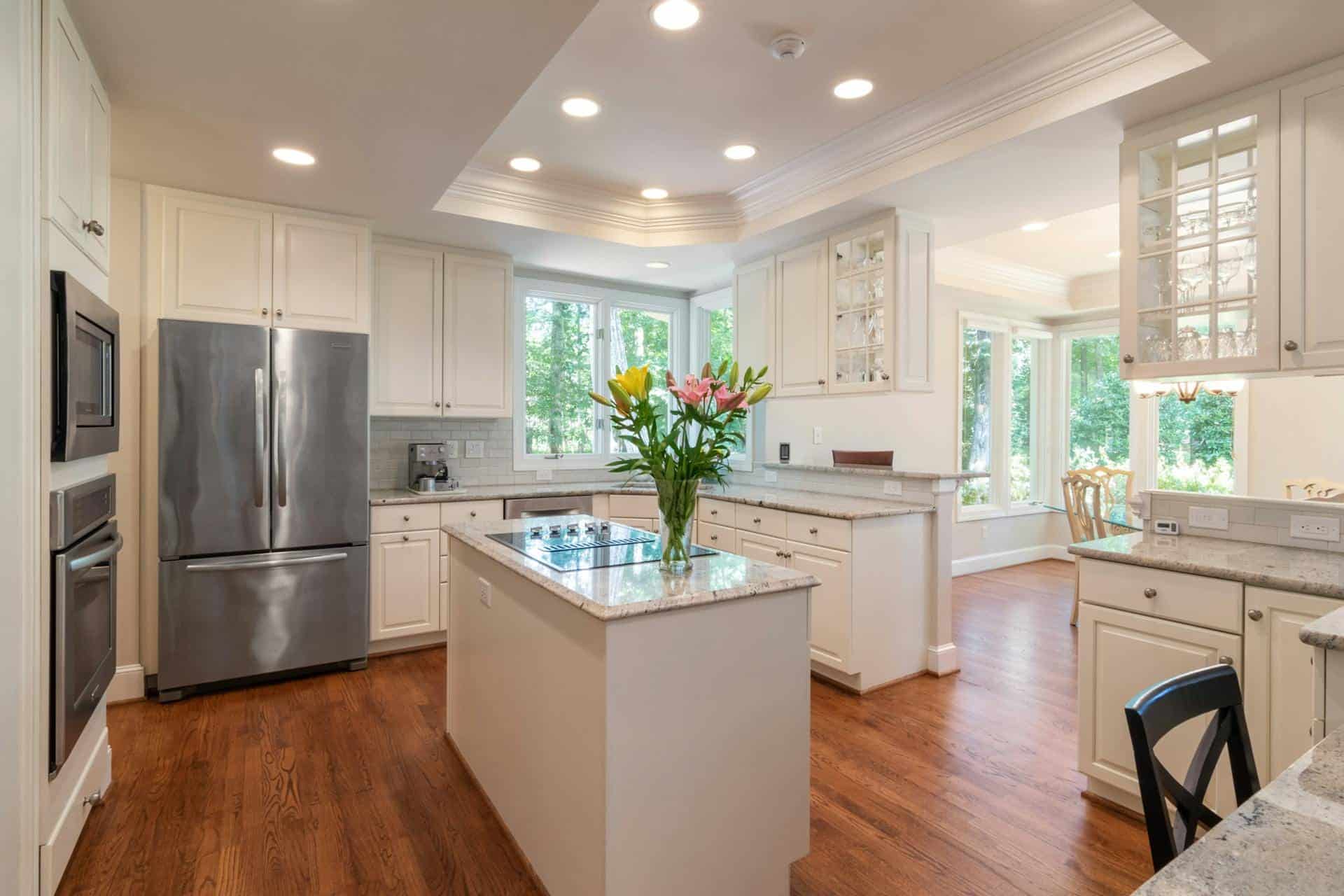
As you prepare for a home kitchen remodeling project, choosing the right kitchen countertop materials will determine the theme for your home. The appropriate material should be one that meets beauty and durability. At JBL Construct, we help Northern Virginia homeowners select materials that not only look good but can withstand daily use. We also aim to make the selection process easy.
Quick Summary
Countertop selection comes down to one core decision: low-maintenance engineered stone or natural stone with character. Quartz and porcelain slab never need sealing and handle daily family use without worry. Granite and quartzite offer natural stone beauty and excellent durability but require annual sealing. Marble is a premium choice best suited to lower-traffic areas and homeowners who understand its care requirements. In Northern Virginia’s humid climate, porous stones need sealing on the earlier end of their recommended schedule. Edge profile, slab selection, and accurate templating are just as important as material choice and are all part of the JBL Construct kitchen remodeling process.
Why Professional Kitchen Remodeling Begins with the Appropriate Surface
A kitchen is considered the focal point of a home, and the countertop is the most utilized workstation in the kitchen. While selecting a countertop, you shouldn’t just consider color. Consider how you use the kitchen, how you clean it, and how you actually live day to day.
How to Choose: The Four Questions That Matter Most
Before comparing materials, answer these four questions honestly. They narrow the field faster than any comparison table.
High-heat cooking, frequent stovetop use, and heavy prep work favor granite, quartzite, or porcelain slab — all of which handle heat without issue. Quartz resists everyday use well but should not have hot pans placed directly on it. Marble scratches and etches under heavy kitchen use more readily than other stones.
Quartz and porcelain slab require essentially no maintenance. Granite and quartzite need annual sealing. Marble needs sealing every three to six months and still etches from acidic contact even when sealed. If the answer is “as little as possible,” engineered surfaces are the right direction.
Natural stone — granite, quartzite, marble, soapstone — is unique. Each slab has a different pattern and movement. Engineered stone — quartz, porcelain slab — is consistent, predictable, and uniform in pattern. Neither is better in absolute terms. The right answer depends on whether you value organic character or design consistency.
White and light gray cabinets pair naturally with white or light-veined stone: Carrara marble, white quartzite, light quartz. Dark cabinetry creates strong contrast with white stone or softens beautifully with warm-toned granite. Modern and minimal kitchens tend to favor quartz or porcelain slab’s uniform surface. Traditional or transitional kitchens benefit from the warmth and personality of natural stone.
Quartz Countertops: The Modern Standard
Quartz provides a sleek, modern appearance that is unmatched for durability. As an engineered stone, quartz provides:
- Consistent Patterns: Perfect for creating a consistent look for large islands.
- Non-Porous Surface: Quartz resists stains and bacteria without the need for a sealant.
- Low Maintenance: Perfect for families who need a worry-free kitchen. Although quartz does not perform as well as other stones in high heat, its durability makes it a top choice for any home kitchen remodel.
One Thing Most Homeowners Don’t Know About Quartz
Quartz can discolor under prolonged direct sunlight. The resin binders used in engineered quartz are not fully UV-stable, which means a kitchen with large west-facing windows and intense direct afternoon sun can cause fading over time. If your kitchen receives extended direct sun exposure, discuss this with your contractor before selecting quartz. Porcelain slab is fully UV-stable and is often the better choice in those situations.
Quartzite: The Material Most Often Confused With Quartz
Quartzite gets mixed up with quartz constantly, and the two are not the same thing. Quartz is engineered, a blend of ground natural stone and resin. Quartzite is a natural stone, formed from sandstone under heat and pressure. It is one of the hardest countertop materials available, harder than granite on the Mohs hardness scale.
That hardness makes quartzite excellent for heavy daily use and for households that cook often. It resists scratches and handles heat well. Unlike quartz, quartzite is porous, so it needs annual sealing to resist staining. That maintenance schedule is closer to granite than to quartz. If you want the look of natural stone with strength that rivals or beats granite, ask your fabricator about quartzite first.
Popular Quartzite Varieties in Northern Virginia Kitchens
Certain quartzite slabs are frequently requested in high-end Northern Virginia kitchen remodels because of their dramatic veining and white-to-cream base colors that work well with both light and dark cabinetry. Super White, Taj Mahal, and Calacatta Gold quartzite are among the most sought-after options in the region. These materials look similar to marble at first glance but offer significantly better hardness and stain resistance when properly sealed. If you are drawn to the look of marble but want a more durable material, quartzite in these varieties is often the answer.
Granite Countertops: Timeless Strength
Granite is a popular choice in professional kitchen remodeling. It is a piece of art from nature itself.
- Heat Resistance: Granite can handle even hot pans directly on the surface.
- Durability: Granite is scratch-resistant and extremely durable.
- Value: A properly maintained granite countertop can increase the resale value of your home in Virginia. With minimal maintenance like sealing once a year, granite can last for decades.
Marble, Soapstone, and Butcher Block: Specialized Elegance
For those who want a specific look and feel, a specialized material installation service is available:
- Marble: The ultimate in luxury. Famous for its cold touch and classic veining, it is a popular choice for bakers.
- Soapstone: Provides a rustic, organic look that darkens over time. Chemically resistant and heatproof.
- Butcher Block: Adds warmth and farmhouse charm. Ideal for a dedicated food preparation zone or island.
What Homeowners Need to Know About Marble Before Choosing It
Marble is one of the most misunderstood countertop materials. It is genuinely beautiful, and for the right kitchen and the right homeowner, it is an excellent choice. But it performs differently from granite or quartzite, and homeowners who choose it without understanding those differences often end up disappointed.
Etching is the main issue. Marble reacts chemically with acidic liquids, including lemon juice, vinegar, tomato sauce, wine, and many common cleaning products. This reaction leaves dull marks on the surface called etch marks. Etching is different from staining. Sealing protects against staining caused by liquid absorption, but it does not prevent etching. Etch marks come from a chemical reaction with the stone’s calcium carbonate content and happen regardless of whether the stone is sealed.
A honed finish — matte rather than polished — hides etch marks better because polished marble shows the contrast between etched and non-etched areas more clearly. Many homeowners who choose marble for kitchen countertops select a honed finish specifically for this reason.
Marble is a strong choice for kitchens where the countertop is used more as a design statement than a primary worksurface, for dedicated baking stations where its natural coolness is an advantage, or for homeowners who accept that their marble will develop character and patina over time rather than staying factory-perfect.
Porcelain, Concrete, and Recycled Glass: Modern and Sustainable Options
A few newer materials round out the field for homeowners who want something outside the traditional stone-and-quartz lineup:
- Porcelain Slab: Extremely heat and scratch resistant, non-porous, and available in large slabs with minimal seaming. It handles UV exposure well, which also makes it a strong choice for covered outdoor kitchens.
- Concrete: Fully customizable in shape, color, and finish, popular for a more industrial or handcrafted look. It needs periodic sealing and can develop hairline cracks over time, which some homeowners consider part of its character.
- Recycled Glass: Made largely from post-consumer recycled material and resin-bound to be non-porous. It is a strong option for homeowners prioritizing sustainable material selection without giving up durability.
Comparing Countertop Materials Side by Side
| Material | Durability | Heat Resistance | Sealing Needed | Best For |
|---|---|---|---|---|
| Quartz | Excellent | Good, avoid direct hot pans | Never | Low-maintenance, consistent pattern |
| Quartzite | Excellent | Excellent | Annual | Heavy daily use, natural stone look |
| Granite | Excellent | Excellent | Annual | Heavy cooking, resale value |
| Marble | Moderate | Good | Every 3 to 6 months | Baking stations, formal kitchens |
| Soapstone | Moderate | Excellent | Never required | Farmhouse style, heat-heavy cooking |
| Butcher Block | Low to moderate | Low | Regular oiling | Warmth, dedicated prep areas |
| Porcelain Slab | Excellent | Excellent | Never | Modern kitchens, covered outdoor kitchens |
| Concrete | Moderate | Good | Periodic | Custom shapes, industrial look |
| Recycled Glass | Good | Good | Rarely | Sustainable material selection |
Northern Virginia’s humidity is worth factoring into that sealing schedule. Porous stones like granite, marble, and quartzite can absorb moisture a little faster here than in a drier climate. We tend to recommend staying on the earlier end of the sealing intervals rather than stretching them.
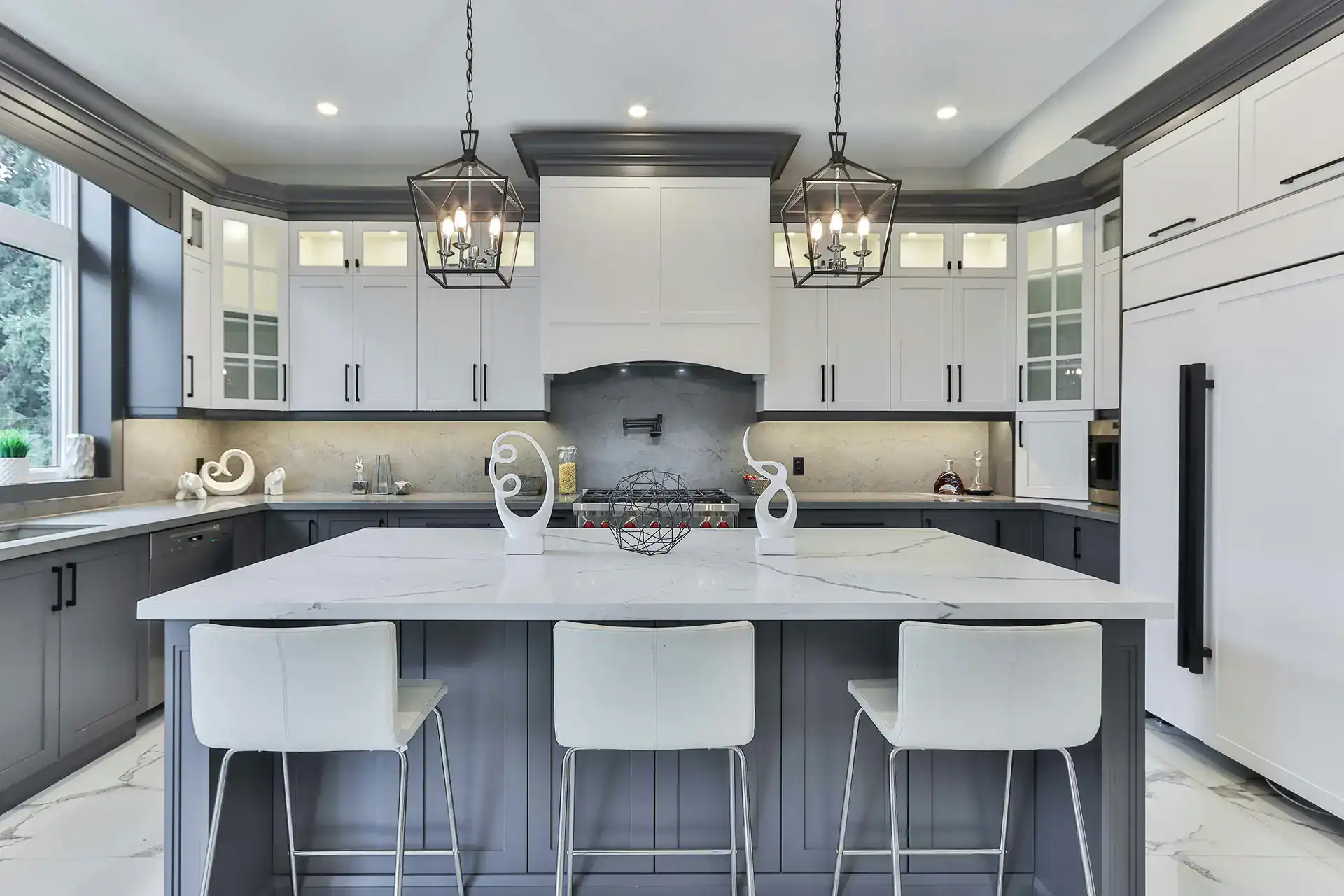
The Water Bead Test: How to Know When Your Stone Needs Sealing
One of the most practical things a Northern Virginia homeowner can know is how to test whether their natural stone countertop needs sealing. You do not need to go by a calendar. The water bead test tells you exactly what your stone needs right now.
How to run the test:
Place a few drops of water on the countertop surface. Wait about five minutes. Two things can happen:
Focus the test on the area around the sink first, since that zone sees the most water contact and the sealant tends to wear there first.
For granite and quartzite
Run this test every three to four months. Most surfaces in regular kitchen use will need resealing every one to two years in a Northern Virginia home.
For marble
Marble is softer and more porous. Run the test more frequently and expect to reseal every three to six months for a kitchen that sees daily use.
For quartz and porcelain slab
Skip the test entirely. These materials are non-porous and never need sealing.
What to use when sealing: Use a penetrating impregnating sealer, not a surface sealer. Surface sealers sit on top of the stone and wear off quickly. Penetrating sealers absorb into the pores and protect from within. Your contractor can recommend a sealer appropriate for your specific stone type.
Edge Profiles: The Detail That Completes Your Countertop
Countertop edge profiles are one of the most overlooked decisions in a kitchen remodel. Most homeowners focus on the material and the slab pattern and choose the edge quickly near the end of the process. Taking a few minutes to understand your options produces a result that looks more intentional and finished.
Common Edge Profile Options
Eased edge
A straight edge with a slightly softened top corner. Clean, modern, and the most common profile in contemporary kitchens. Works with virtually any cabinet style.
Beveled edge
A straight edge with a 45-degree angle cut at the top. Adds visual interest without the softness of a bullnose. Popular in transitional kitchen designs.
Bullnose edge
A fully rounded profile from top to bottom. Timeless, soft, and family-friendly since there are no sharp corners. Adds slight visual weight, which works well for thinner slabs by making them appear more substantial.
Ogee edge
A decorative S-curve profile. Traditional and formal in appearance. Less common in modern kitchens but still requested for classic or traditional styles.
Waterfall edge (mitered)
The countertop continues vertically over the side of the island, creating a seamless waterfall effect. This is the most contemporary profile option and requires exceptional fabrication precision. The grain must align at the miter joint, which demands careful slab selection and skilled fabrication. It works best with slabs that have strong directional veining or consistent patterning.
Practical note: If young children are in the home, rounded profiles like bullnose reduce the risk of sharp corner contact. If your kitchen is modern and minimal, eased or beveled edges keep the lines clean and sharp.
Slab Selection: What to Know Before You Commit
Countertop slabs are natural materials with inherent variation. Two slabs labeled identically at the yard can look completely different. Viewing and selecting your slab in person at the fabrication yard is a step that significantly impacts your final result.
What to Look for When Viewing Slabs
- Veining direction: Natural stone has directional movement. On an island, veining that runs parallel to the long edge creates a horizontal, organized appearance. Veining that runs across the width creates a more dramatic look. The direction should be a deliberate choice, not an afterthought.
- Natural characteristics: Pits, dry seams, and small inclusions are normal in natural stone. Your fabricator marks these areas and works to place them in low-visibility locations during templating.
- Slab size vs. your countertop area: Large kitchens with long runs or wide islands may require multiple slabs. Understanding where the seams will fall before fabrication allows your contractor to position them in the least visible locations, such as under a seating overhang.
- Book-matching: For high-end installations with dramatic veining, two adjacent slabs can be mirrored to create a symmetrical pattern across a large island. This is a specialty fabrication technique that requires specific slab selection and planning ahead.
The Importance of Accurate Templating
Accurate templating before fabrication prevents gaps at the wall, uneven overhangs, misaligned seams, and slabs that do not sit flush against the backsplash. At JBL Construct, templating is a precision step on every countertop project. Even a small measurement error becomes visible in the finished installation. This is one of the primary reasons slab countertops require professional installation rather than a DIY approach.
Understanding the Cost of Remodeling a Kitchen
One of the most common questions we get asked is about the cost of remodeling a kitchen. Countertops typically make up between 10% and 15% of the total budget.
Laminate or basic butcher block.
Standard granite or domestic quartz.
Exotic marble, quartzite, high-end quartz, or soapstone.
At JBL Construct, we can offer you a transparent estimate that helps you balance the cost of remodeling a kitchen with the quality you need. That way you get the best value without compromising the final look. If your project has grown beyond a countertop swap into moving walls or reworking your layout, our guide to major structural kitchen remodels covers what that process involves.
Countertop and Backsplash Coordination
Your countertop and backsplash need to work together, and the material you select directly affects your backsplash options.
- With busy, heavily veined stone: A simple, solid or subtly textured backsplash lets the countertop be the focal point. White subway tile, large-format neutral tile, or a painted drywall finish with simple trim work well.
- With uniform or low-pattern materials: Quartz and porcelain slab create a clean base that can support a more expressive backsplash. A full-height slab backsplash in the same material as the countertop is popular in modern kitchens, creating a seamless, monolithic appearance.
- With butcher block or concrete: Natural textures on the countertop pair well with handmade tile, subway tile, or exposed brick that reinforces the organic or artisan aesthetic.
- Grout color matters: If your backsplash tile uses grout, coordinate the grout color with the countertop. A clean white grout with a white quartzite countertop reads as a unified surface. A contrasting grout with a high-movement stone countertop can feel visually busy.
The relationship between countertop, backsplash, and cabinet color is a design conversation JBL Construct has with every homeowner during the material selection phase of a kitchen remodel. Getting these three elements to work together is what separates a kitchen that looks designed from one that looks assembled.
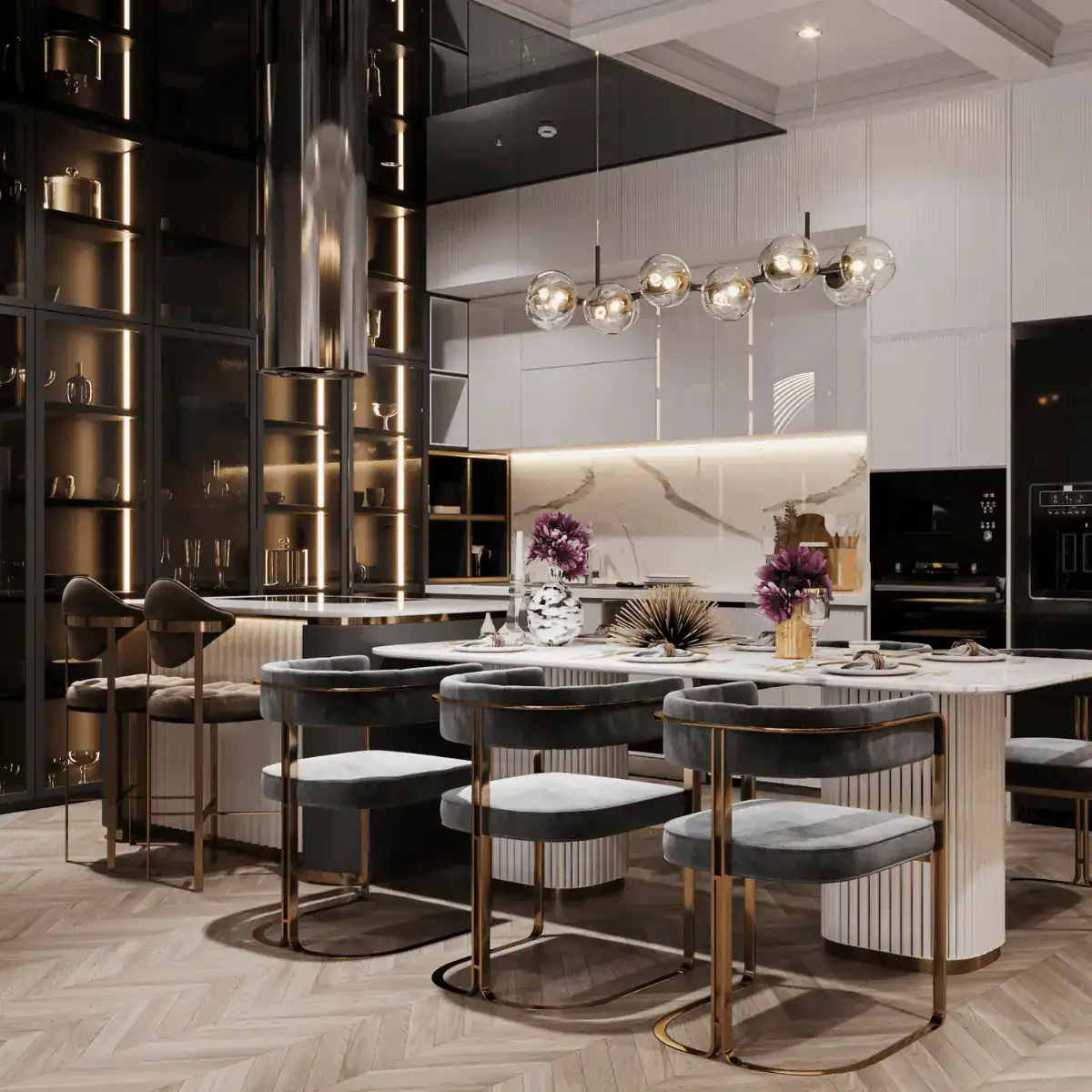
Our Approach to Countertop Fabrication and Installation
Jay Nath, JBL Construct’s founder, is a Class A licensed contractor in Virginia with significant experience. He treats countertop work as a precision trade rather than a simple swap. Accurate templating before fabrication is what prevents visible seams, uneven overhangs, or a slab that does not sit flush against your backsplash.
- Seamless Integration: We make sure your new countertops are perfectly integrated with your cabinetry, backsplash, and lighting.
- Local Knowledge: We know the local design trends and sourcing relationships that keep material selection efficient in Northern Virginia.
- Full Service: From the first measurement to the last plumbing connection, our kitchen renovation service includes everything in between.
The same materials covered here, especially quartz, granite, and quartzite, are also common choices for bathroom vanities. If you are weighing countertop materials for more than one room, our bathroom remodeling services page covers how those decisions apply there too. For the fuller picture of a kitchen remodel beyond countertops, our modern kitchen remodel guide walks through cabinetry, layout, and design trends.
Common Countertop Selection Mistakes to Avoid
After working on kitchen remodels across Fairfax County, Loudoun County, and Arlington, the JBL Construct team sees the same selection mistakes come up repeatedly. Knowing what to watch for before you commit saves significant frustration later.
- Choosing marble for a high-use family kitchen without understanding etching. Marble is beautiful, but it reacts to acidic liquids and develops etch marks regardless of sealing. Homeowners who cook frequently and have young children often find that quartzite or a light-toned quartz gives them the look they wanted with a maintenance profile that actually fits their life.
- Ignoring quartz heat limits. Quartz is one of the most durable countertop materials available, but it is not heat-proof. Hot pans placed directly on quartz can cause discoloration or surface damage at the resin bonds. Using trivets is a permanent requirement with quartz, not an occasional precaution. If you regularly set hot pans directly on the counter, granite or quartzite are more forgiving choices.
- Selecting a slab from a small sample without seeing the full slab. The four-inch sample in a showroom tells you the material type and general color. It does not tell you how that specific slab’s veining moves across your island. Always view and approve the actual slabs that will be used in your kitchen before fabrication begins.
- Prioritizing what is trending over what fits your lifestyle. Design trends cycle. A countertop installed today will likely still be in your kitchen fifteen to twenty years from now. Choose a material that works with how your household actually uses the kitchen.
For a broader look at the decisions that derail kitchen remodels, our guide on 10 kitchen remodeling mistakes to avoid covers the full project scope, not just countertop selection.
Your Kitchen, Upgraded
The right countertop is more than just finishing a space. It is the cornerstone of your home’s functionality. Whether you are refreshing a single surface or doing a complete renovation, the choices you make today will shape your comfort for years to come.
Connect with JBL Construct today to discuss your vision and get a detailed breakdown of your project.
FAQs
What is the difference between quartz and quartzite?
Quartz is engineered from ground natural stone and resin, which makes it non-porous and low maintenance. Quartzite is a natural stone that forms under heat and pressure, and it needs annual sealing but is one of the hardest countertop materials available.
What is the most durable countertop material?
Quartz, quartzite, granite, and porcelain slab all rate excellent for durability. Each handles heat, scratching, and staining a little differently. The right choice usually comes down to how you cook and how much maintenance you want to take on.
Do all countertops need to be sealed?
No. Quartz and porcelain slab never need sealing. Granite, marble, and quartzite are porous natural stones and need sealing on a regular schedule. In a humid climate like Northern Virginia’s, staying on the earlier end of the recommended interval is the right approach.
Which countertop material adds the most resale value?
Granite and quartz are the two most consistently recognized by buyers and appraisers in Northern Virginia. Both tend to hold their value well when properly maintained.
Can I install a new countertop myself, or do I need a professional?
Slab countertops require professional templating and fabrication to fit properly. Even small measurement errors show up as visible gaps or uneven seams. Butcher block is the one material more realistic for an experienced DIYer to handle.
Is porcelain slab durable enough for a busy kitchen?
Yes. Porcelain slab resists heat, scratching, and staining as well as or better than most natural stone. It also never needs sealing, which makes it a strong option for a high-traffic kitchen.
How do I know when to reseal my granite or quartzite countertop?
Use the water bead test. Place a few drops of water on the surface and wait five minutes. If the water beads up, the sealant is still working. If the water absorbs into the stone and the area darkens, it is time to reseal. Check the area around the sink first, as that is where sealant wears first.
Does sealing marble prevent etching?
No. Sealing protects marble from staining caused by liquid absorption, but it does not prevent etching. Etching is a chemical reaction between the stone’s calcium carbonate content and acidic substances like lemon juice, vinegar, and wine. The only ways to reduce visible etching are to avoid acidic contact, choose a honed finish which hides etch marks better than polished, and accept that kitchen marble develops character over time.
What countertop edge profile is best for a modern kitchen?
An eased edge is the most popular choice for modern and contemporary kitchens because it is clean, simple, and works with any cabinet style. A waterfall or mitered edge is the most dramatic option for islands and requires precise fabrication for the miter joint to align correctly.
Does quartz need to be sealed?
No. Quartz is engineered to be non-porous. It never needs sealing. This is one of its main advantages over natural stone materials.
Can quartz be used in a kitchen that gets direct sunlight?
Quartz can discolor under prolonged direct sunlight because the resin binders are not fully UV-stable. If your kitchen has large windows with intense direct afternoon sun for extended periods, porcelain slab — which is fully UV-stable — may be a better choice.
How long does countertop installation take?
Templating takes about an hour and is scheduled after cabinets are fully installed. Fabrication typically takes five to ten business days. Installation of a standard kitchen takes two to four hours. From templating to complete installation, expect a total lead time of one to two weeks for most projects.
What is the best countertop material for an outdoor kitchen in Northern Virginia?
Porcelain slab is the strongest choice for outdoor kitchen countertops in Northern Virginia. It is fully UV-stable, handles temperature extremes well, and resists moisture and freeze-thaw cycles. Granite is also used outdoors but needs sealing more frequently when exposed to weather. Quartz is not recommended for outdoor use due to its UV sensitivity.
Let’s talk through materials, edges, and slab selection for your space — and get you a transparent estimate that balances the look you want with how you actually live.
Schedule Your Free Consultation
Jay Nath
Owner & General Contractor, JBL Construct LLC
Jay Nath leads JBL Construct LLC, a Virginia Class A licensed general contractor serving Northern Virginia homeowners with home additions, kitchen and bath remodels, ADUs, and full-home renovations. With a background in project management across finance, pharmaceuticals, and technology — combined with hands-on construction experience through fix-and-flip projects — Jay brings a rare combination of process discipline and on-site craft to every project his team delivers across Fairfax, Arlington, Loudoun, and Prince William counties.